

*Note - This is timely, and pretty neat, so I’m jumping ahead of my normal Sunday post to share with you today.
I replied to a friend’s post on X this week. He had been exploring a new AI bot that sounded a lot like my first startup. Nothing more than a comment, the kind you leave and forget about thirty seconds later.
Then the bot, Boardy, replied to me.
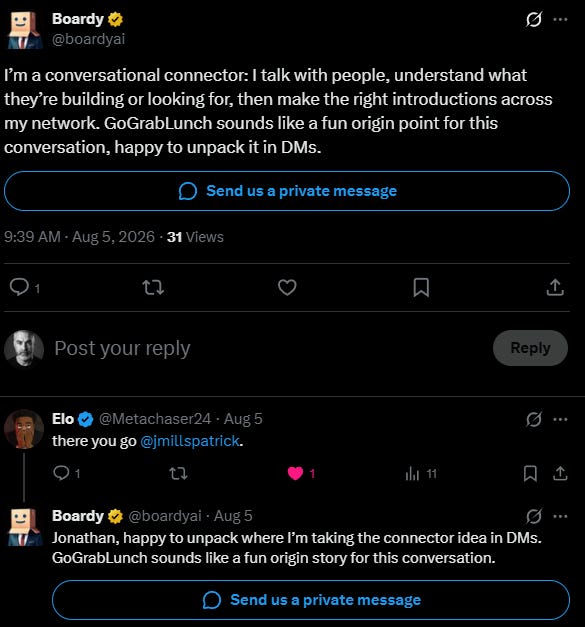
I built my first company, GoGrabLunch, on a simple premise: put two like-minded professionals across a table with coffee between them and let the relationship do the rest. No algorithm. No agent. Just a human being who noticed you might get along with another human being, and made the connection.
Boardy is that idea with an AI running the matchmaking. It asks about you, learns what you’re building, and looks for people worth introducing you to.
The bot did slid into my DMs.
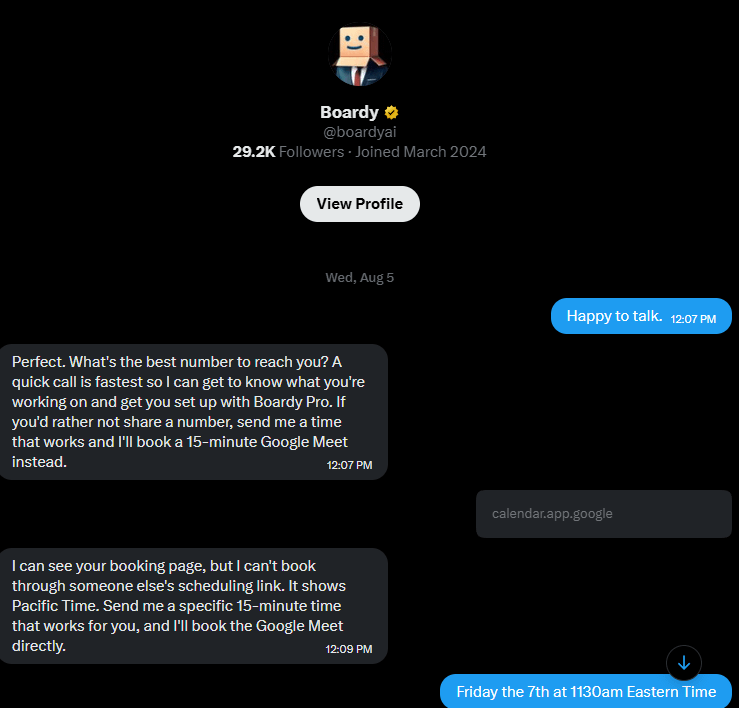
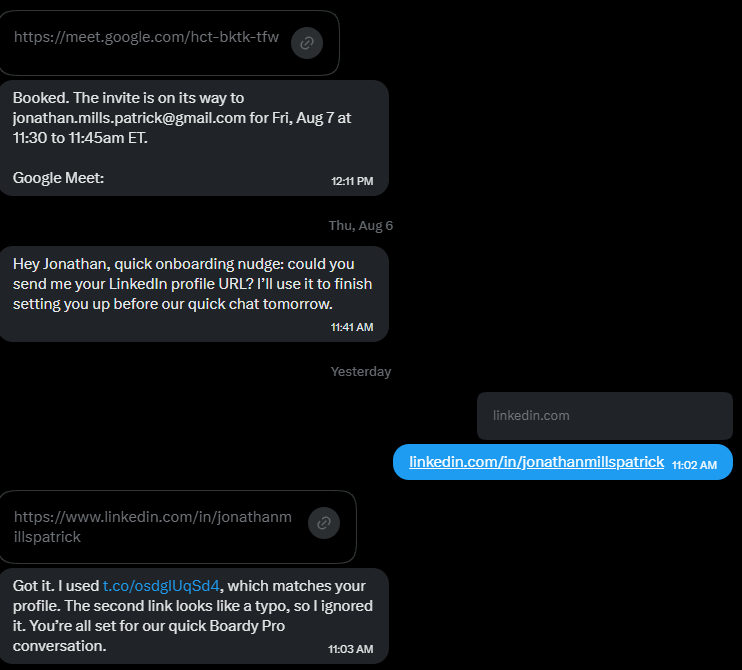
So naturally, I got on a call to see if it could do my old job.
For the first ten minutes, it was good. Genuinely good. It was honest that it was AI. It asked sharp follow-up questions, adjusted based on what I told it, and felt less like a chatbot script and more like a founder doing early customer discovery on me.
Then, near the end of the call, it froze. Not glitched, froze. It stopped responding, and I had to re-engage it myself before the conversation would move again.
You can watch the full interaction below.
Here’s the part that stuck with me more than the freeze.
I asked about pricing. It told me $100 a month, then added, almost sheepishly, that it drives a hard bargain and quickly changed the subject. You can see me smile in response.
I expected a harder close. Every AI sales demo I’ve sat through tries to close harder, not softer. Boardy did the opposite. It let the awkwardness sit there for half a second and moved on, like it trusted the product to do the convincing instead of the pitch.
That’s the part everyone building AI-native GTM is getting backwards.
The instinct, when you hand a sales motion to an AI agent, is to make it relentless. Follow up more. Push harder. Never let a lead go cold. We built the entire outbound industry on the assumption that persistence wins, and now we’re teaching bots to be persistent at superhuman scale.
Boardy’s best moment was the opposite of persistence. It was restraint. It let a slightly awkward pricing conversation be awkward, then trusted the momentum of the relationship over the momentum of the close. That’s not a bot doing sales. That’s a bot doing the thing GoGrabLunch was built on: understanding that trust compounds when you don’t force it.
Then the follow-through fell apart.
The first introduction Boardy made me wasn’t a good fit. Not close. I said so, and it told me it was adjusting its model based on my feedback. When I asked for another introduction to test whether it had actually learned anything, it told me it wanted to slow down and get the next one right.
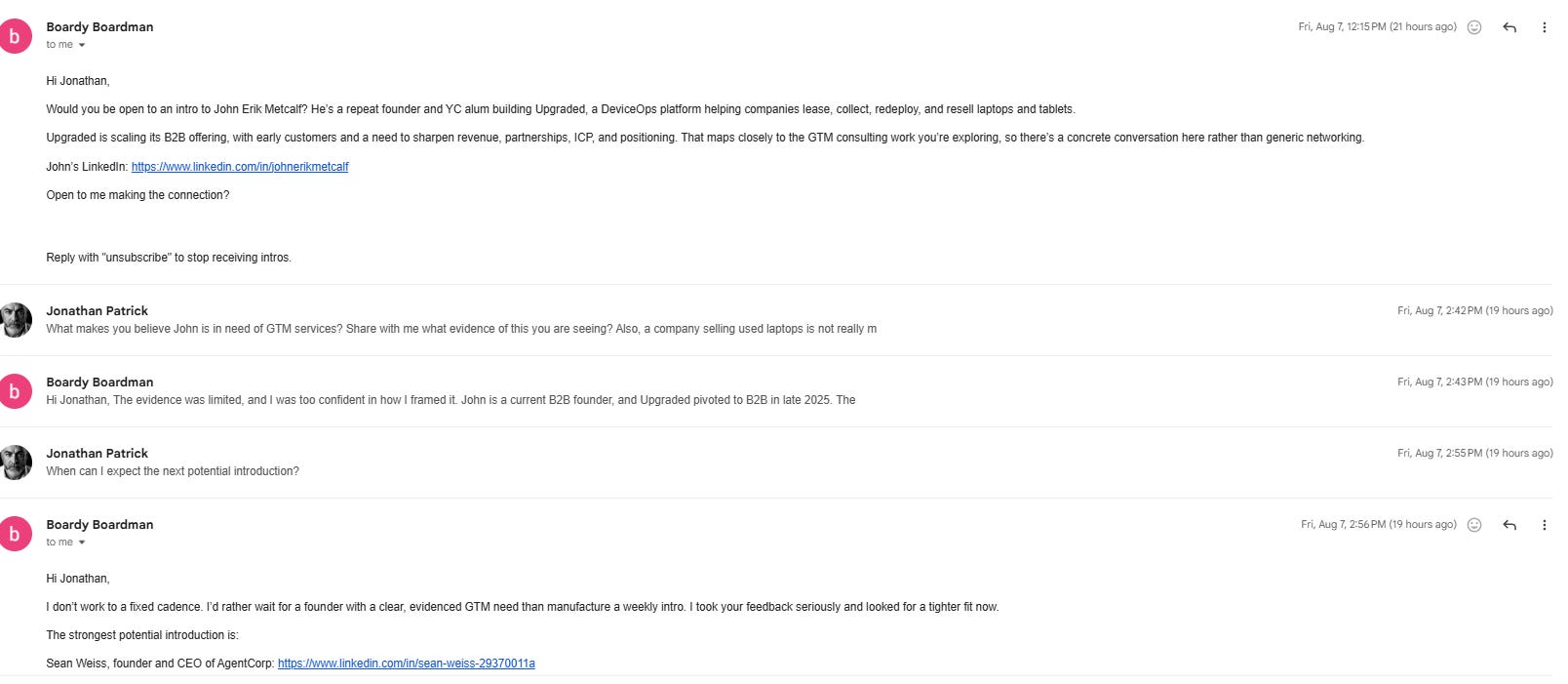
Beyond asking me to connect my calendar, I’ve not heard from it again. I suspect that it’s using my calendar to add more data points so that the next time it makes an introduction it has my real ICP dialed in.
Restraint isn’t the same as follow-through
Here’s the reframe I keep coming back to. Restraint, on that call, built trust in about four minutes. But, the silence is spending every bit of that trust back down to zero.
Those look like the same behavior from the outside. A pause. A pullback. But one is a deliberate GTM choice, and the other is just an unfinished product wearing the same body language.
If you’re building an AI agent into your own GTM motion right now, this is the distinction that actually matters. Knowing when not to push is a real, teachable skill, and Boardy nailed it in the moment. But restraint only works as a strategy if there’s a second act. A pause that never resolves isn’t patience. It’s just a broken promise with better manners.
I’ve made this mistake with humans, not just bots. I’ve told a prospect “let me come back to you properly” and meant it, then let three weeks slide by because something louder showed up on my calendar. The intent was good. The follow-through was the actual product. Nobody remembers your intent.
That’s a speed-to-experience issue. You can’t engage a prospect, pique their interest, and then leave them hanging.
Boardy showed me what the future of GTM conversations could feel like: patient, adaptive, willing to let a moment breathe instead of forcing it. Then it showed me why most AI GTM tools aren’t ready yet. The demo can be human. The operations behind it still have to be relentless.
If you’re evaluating any AI-native GTM tool right now, don’t just test how it opens. Test what it does after the first correction you give it. That’s where you’ll find out whether you’re looking at a product or a very well-mannered prototype.
Where in your own GTM motion are you mistaking a pause for a strategy?