

Where This Came From
A few months ago, my friend Chris Marr, who runs The Question First Group, wrote something that stopped me mid-scroll.
An opportunity had landed on his desk. The kind his company would have said yes to a month earlier, no questions asked. This time, one of the owners turned it down. Wrong fit. Not the niche they’d chosen. Not the direction they were building toward.
One sentence. And I could not stop thinking about it, because I could not have done what that owner did.
I say yes to everything. I know exactly why.
That same week, I called my friend Tom. Thirty seconds into the call, I could hear it. That low grade burnout hum in his voice. He described his week like a man trying to catch six things falling off a shelf at once. Arms everywhere. Nothing caught.
I was not in a position to help him. I was living his week.
I had admitted the same thing to myself that same morning, for maybe the fifth time that year. I cannot say no.
Back in June, I had announced a summer sabbatical from my side projects. Step back. Simplify. Breathe. It lasted three weeks. Three genuinely great weeks, no inbox anxiety, no chasing “just one more opportunity.”
Then I got restless, and restlessness always disguises itself as productivity. I called it strategic planning and got back to work. I looked at where my side income actually came from and found that ninety five percent of it traced back to two channels, out of a dozen things I was spending time on. The math was obvious. Stop touching the other ten.
The next day I got offered a five thousand dollar a month opportunity sourced through one piece of unrelated content. I canceled the sabbatical. I said yes.
Within forty eight hours, I regretted it. Not because the work was bad. Because I had been untrue to what I had just decided mattered.
I have spent my career building companies. I have run capital efficiency audits on startups burning cash without moving the needle. It took me an embarrassingly long time to turn that same audit on myself.
This guide is that audit, rebuilt for a person instead of a company.
The Premise
Companies burn cash without ever finding product market fit. People burn time and energy the exact same way, and almost nobody names it that plainly.
Runway is not just a company metric. It is personal too. It is how much capacity you have left before something breaks, whether that something is your business, your health, or your patience with the people who love you.
I built a Capital Efficiency Scorecard for the founders I advise. Five categories, a weight, a score, a total. It tells them the truth about their business faster than a board meeting ever could.
This is that same scorecard, aimed inward.
Five categories. A weight. A score. A total. Twenty minutes of honesty, and you will know exactly where your leak is.
The Five Categories
I. Time Payback
What it measures: how long before a commitment starts paying you back, instead of just costing you.
In business, we track CAC payback: how many months of revenue it takes to recover what you spent acquiring a customer. Anything that pays back too slowly gets cut, no matter how good it felt to win.
I have said yes to opportunities that never paid me back in anything. Not money, not energy, not meaning. I kept them anyway because quitting felt like admitting I was wrong to start.
Score 1 to 5. A 1 means something in your life has been a pure drain for months with no sign of turning. A 5 means most of what you carry starts paying you back quickly and keeps paying.
Ask yourself: What is something you said yes to recently that still has not paid you back?
II. Energy Retention
What it measures: whether the things already in your life sustain themselves, or whether they collapse the moment you stop forcing them.
Net revenue retention tells a founder whether the business grows on its own, without new sales spend propping it up every quarter. It is the difference between a business and a treadmill.
I have built relationships, routines, and side projects that only existed because I kept white knuckling them. The second I let go, they were gone. That is not commitment. That is life support.
Score 1 to 5. A 1 means everything falls apart the moment you stop pushing. A 5 means most things run without you forcing them.
Ask yourself: What in your week would collapse in a month if you stopped forcing it?
III. Margin
What it measures: after the real cost of a commitment, time, stress, favors owed, how much is actually left over for you.
Gross margin tells you what is left to fund the rest of the business after the cost of delivering the product. Most people never calculate their personal version of this number, which is exactly why they are always tired and never sure why.
Score 1 to 5. A 1 means you are underwater on almost everything you do. A 5 means most of what you carry leaves you with real surplus, not just survival.
Ask yourself: Where are you spending more of yourself than you are getting back, and calling it normal?
IV. Burn Rate
What it measures: how much of yourself you are burning for every unit of visible progress.
A burn multiple over one point five is a red flag for any company I audit. It means you are torching cash faster than you are creating value. People run the same broken math with sleep, patience, and presence, and nobody flags it because there is no board meeting for a life.
Score 1 to 5. A 1 means you are burning hard for almost no output. A 5 means your pace is sustainable and your output actually matches what you are spending to get it.
Ask yourself: If your energy were a bank account, are you overdrawn right now?
V. Compounding Investment
What it measures: whether the time you invest in yourself is actually building on itself, or just occupying you.
R&D to revenue tells a company whether its investment in new features is producing proportional growth, or whether it is time to kill the project. I ask founders this question constantly. I rarely ask it about my own year.
Score 1 to 5. A 1 means you are busy, but nothing you are doing is building on anything else. A 5 means this year is clearly building on last year, and next year will build on this one.
Ask yourself: What are you doing right now purely because it feels productive, not because it is actually building toward something?
The Scorecard
Fill this in honestly. Nobody sees it but you.
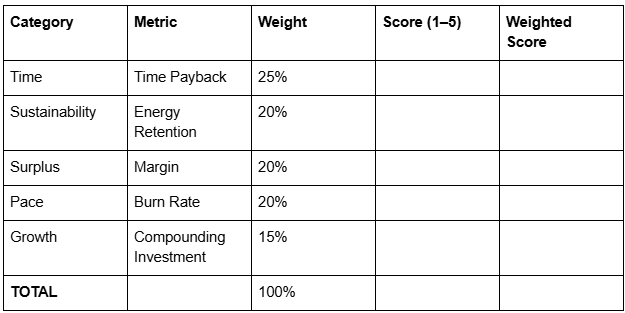
Under 2.5: You are in what I call the Bridge Round Trap, personally. You are surviving quarter to quarter, saying yes to whatever shows up because it is easier than sitting still long enough to see the leak.
2.5 to 3.5: Functional, but leaking. You are not in crisis. You are also not getting the return you should be, given what you are putting in.
3.5 and up: A genuinely efficient operator. Rare. Worth protecting, not just celebrating.
The Ego Tax
I have run growth audits where the biggest problem was never the market. It was the founder. A third of their engineering time was going toward features nobody asked for, built because the founder wanted them, not because the business needed them.
People do the exact same thing with their lives. We keep commitments alive that serve nothing, because ending them would mean admitting we were wrong to start them.
I did not cancel my sabbatical because the five thousand dollar opportunity was good. I canceled it because sitting still long enough to actually rest felt like losing, and some part of me still needed to prove I had not lost.
That is not ambition. That is an ego tax, and it is the most expensive line item most people never audit.
The threat that built the habit is usually long gone. I have been laid off before, more than once. The last time, my daughter was nine months old and we had nothing saved. I told myself never again, and spent the next decade building like I was still standing in that kitchen with an empty bank account.
We are not wealthy, but we are financially secure now. We could absorb a real income gap without blinking. The threat is gone. The reflex is not. That gap between the two is where the tax gets paid, every single week, usually without your permission.
The Action
Before you say yes to anything new, run it through these three questions.
1. Does this touch one of the things that actually drives results for me, or does it just feel productive?
2. Would I say yes to this today, knowing what I know now, or only because it showed up fast?
3. Am I solving a real problem, or am I still responding to a threat that is not there anymore?
I did not ask myself these before I took that five thousand dollar a month deal. I already knew what the answer would have been.
One Last Thing
Chris’s co-owner did not turn that opportunity down because he was disciplined. He turned it down because he knew, with precision, what his business was and was not, and he trusted that clarity more than the dollar signs in front of him.
That is not a personality trait. It is a filter. You can build one, even if your default setting has always been yes.
Run this audit again in thirty days. The line that changes the most is the one that was lying to you the first time.
What is the one line on your scorecard you already know is lying to you?